
The 1958 quarter value does not follow one simple rule. The date is the same, but the market is not. A 1958 Philadelphia quarter, a 1958-D, a 1958 proof, and a 1958 Type B Reverse can trade in very different ways. The differences come from mintage, survival, grade, proof status, and variety interest. That is why this date still gets attention.
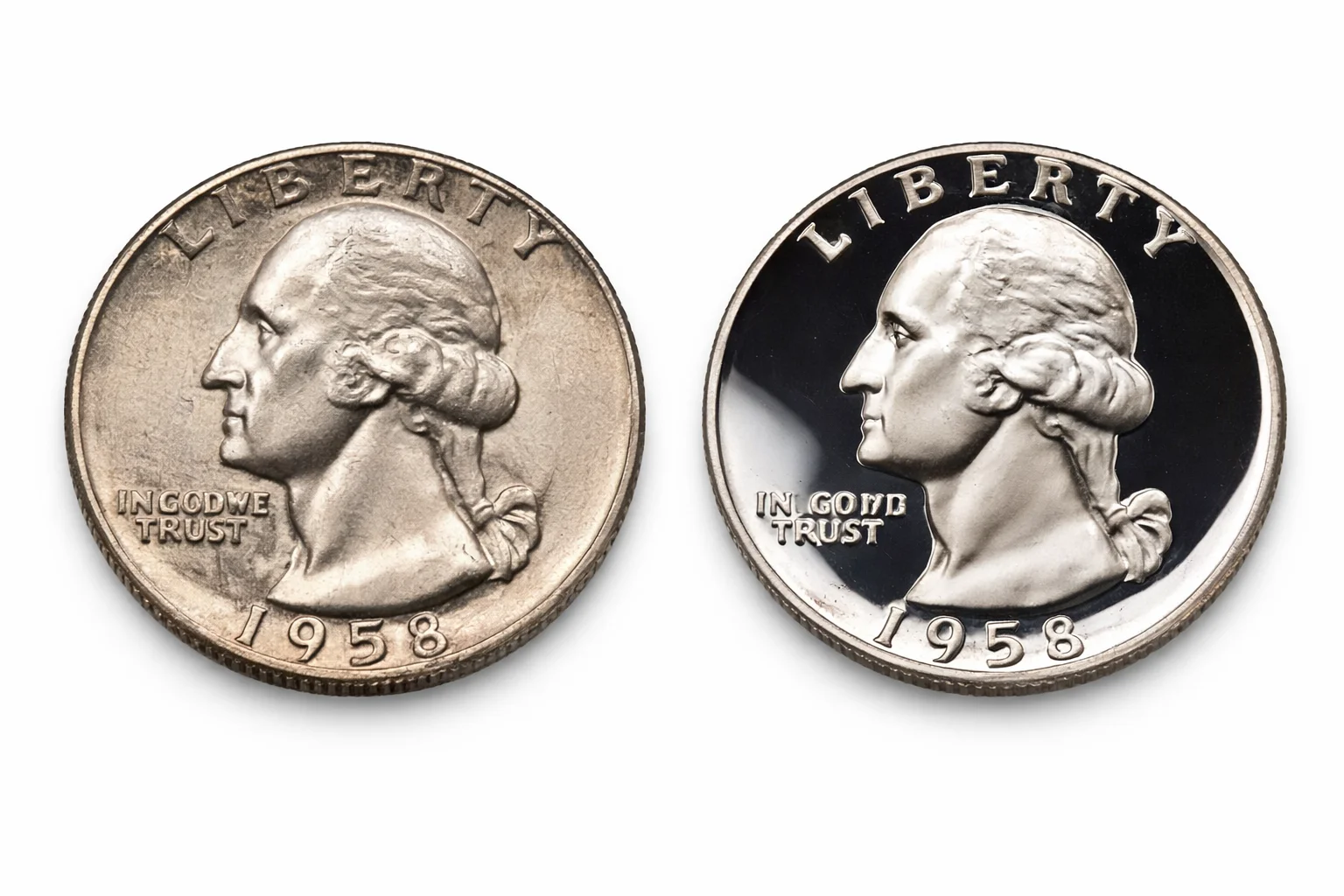
Basic Facts About the 1958 Quarter
The 1958 quarter is a Washington quarter designed by John Flanagan. It has the standard pre-1965 composition of 90% silver and 10% copper. This and other basic specifications do not change across the main 1958 versions.
| Feature | 1958 Quarter |
| Coin type | Washington quarter |
| Designer | John Flanagan |
| Composition | 90% silver, 10% copper |
| Weight | 6.30 grams |
| Diameter | 24.30 mm |
| Edge | Reeded |
| Main versions | 1958, 1958-D, 1958 Proof, 1958 Type B Reverse |
The market split starts when collectors separate the business strikes from the proof and then check whether a Philadelphia coin has the Type B Reverse. That is where this date becomes more interesting than a standard silver quarter from the same era.
The Four Versions That Shape the 1958 Quarter Market
The first version is the regular Philadelphia strike. PCGS lists its mintage at 6,360,000. That is the lower mintage business strike for the year. It sounds scarce, but the market does not treat every nice 1958-P as a major rarity. Many original rolls were saved, which makes the coin more available in Gem than the mintage alone suggests.
The second version is the 1958-D. PCGS lists the mintage at 78,124,900. In lower grades, this is the more available business strike. In stronger grades, the picture changes. The 1958-D is about twice as rare in Gem condition as the 1958 Philadelphia coin. That is one of the most important facts for this date.
The third version is the 1958 proof. The proof mintage is 875,652 pieces. This is a collector issue, not a coin made for circulation. The proof market works on a different scale. Clean mirrors, low hairlines, and stronger contrast matter much more here than on a standard business strike. Only the Ultra Cameo level is truly rare for the 1958 proof quarter.
The fourth version is the 1958 Type B Reverse, cataloged by PCGS as FS-901. This is a Philadelphia business strike variety. It is not a separate date. It is a recognized reverse type that collectors track on its own. NGC explains the visual difference clearly: on the Type B Reverse, the letters ES in STATES are clearly separated, and E PLURIBUS UNUM appears in higher relief.
| Version | What it is | What collectors check first | Why it trades differently |
| 1958 | Philadelphia business strike | grade, luster, marks | lower mintage, but many saved rolls |
| 1958-D | Denver business strike | grade, surface quality | common in lower grades, harder in Gem |
| 1958 Proof | collector strike | mirrors, hairlines, contrast | separate proof market |
| 1958 Type B Reverse | Philadelphia variety | reverse details | variety premium beyond the normal date |
That table shows why the date cannot be priced as one coin. The market does not ask only, “Is it 1958?” It asks, “Which 1958 quarter is it?” That is the better question.
Why These Four Versions Should Not Be Priced the Same
Mintage explains only part of the market. The 1958 Philadelphia quarter has the lower business-strike mintage, but many rolls were saved. That changed survival. The 1958-D quarter has a much larger mintage, but strong Gem coins are tougher than the raw number suggests. The proof belongs to a different price structure from the start. The Type B Reverse adds a separate variety premium.
Each version moves for its own reason:
- 1958 Philadelphia — lower mintage, but better survival in nice grades;
- 1958-D — common by production, tougher in stronger condition;
- 1958 Proof — valued by mirrors, preservation, and contrast;
- 1958 Type B Reverse — valued as a recognized variety, not just a date coin.
This is also where a coin scanner app has a clear role, but not as a grading shortcut. On a date with several similar-looking versions, collectors use it to keep coin cards together, compare saved examples side by side, and review details such as format, surface style, and reverse type without mixing one lane with another.
1958 Quarter Value Overview
The broad value picture is easier to read once the versions are separated. NGC places circulated 1958 Philadelphia quarters in the roughly $15.25 to $17.75 range and circulated 1958-D coins in the roughly $14.75 to $17.25 range. Those numbers show that lower-grade coins stay fairly close. The larger gaps appear later.
| Version | Typical lower-range value | Where premiums begin | Main value driver |
| 1958 circulated | around silver-driven circulated levels | better Mint State | grade and eye appeal |
| 1958-D circulated | around silver-driven circulated levels | better Mint State | grade and scarcity in Gem |
| 1958 Mint State | above circulated levels | upper Gem | preservation |
| 1958-D Mint State | above circulated levels | upper Gem | condition rarity |
| 1958 Proof | collector issue, still accessible in ordinary grades | high proof grades | mirrors and preservation |
| 1958 Type B Reverse | above the normal date in a comparable grade | better certified grades | recognized variety premium |
The table does not mean every nice 1958 quarter is expensive. It means the market widens as soon as grade, proof contrast, or variety status enters the picture. That is why a guide to 1958 quarter value has to stay version-specific.
Philadelphia vs Denver: The Mintage and the Survival Story
The Philadelphia and Denver coins make a good comparison because they prove that mintage is not everything. On paper, the 1958 Philadelphia coin looks scarcer. In practice, many were saved in rolls. This made the coin relatively available in Gem. That is why the lower mintage does not guarantee a stronger premium in every Mint State grade.
The Denver coin shows the opposite pattern. It is common by production, but better pieces thin out. The 1958-D is about twice as rare in Gem as the 1958 Philadelphia issue. That changes the market in the upper grades. It also explains why the 1958-D record is so strong at the top end.
A simple comparison helps:
- Lower grades: P and D stay fairly close
- Gem grades: Denver becomes tougher
- Top-pop grades: the market becomes auction-driven
That is the real split between the two business strikes. It is not only about how many were made. It is also about how many survived at the level collectors want today.
Proof Coins: Where Surfaces and Contrast Take Over
The 1958 proof quarter needs its own section because it should not be priced like a normal business strike. The proof was made for collectors. The fields are mirrored. The surfaces should be cleaner. Hairlines matter. Frost matters. Contrast matters. PCGS lists the proof mintage at 875,652, and NGC notes that only the Ultra Cameo level is truly rare.
| Proof type | What collectors check | Why the value changes |
| Standard Proof | mirrors, hairlines, marks | collector premium, but still accessible |
| CAM | frost-to-field contrast | stronger demand |
| DCAM | deep contrast with high preservation | strongest proof premiums |
The market premium comes from contrast and preservation, not from silver content.
Type B Reverse: The Small Detail With a Separate Market
The Type B Reverse is the most specialized part of the 1958 quarter market. It does not apply to every coin. It applies to Philadelphia pieces that show the proof-style reverse. NGC describes the main markers clearly: the letters ES in STATES are clearly separated, and E PLURIBUS UNUM appears in higher relief.
That detail can change the value path of an otherwise normal-looking quarter. PCGS treats the 1958 Type B Reverse as a recognized variety with its own listing and an auction record of $4,800 in MS67+. That is a strong result for a reverse variety on a date many collectors first treat as a basic silver quarter.
Collectors often check Type B last. That is a mistake. On this date, it deserves a direct look, especially on Philadelphia coins that already have better surfaces or a more prooflike look. The reverse is where the real difference sits.
Grade: Where the Versions Start to Separate
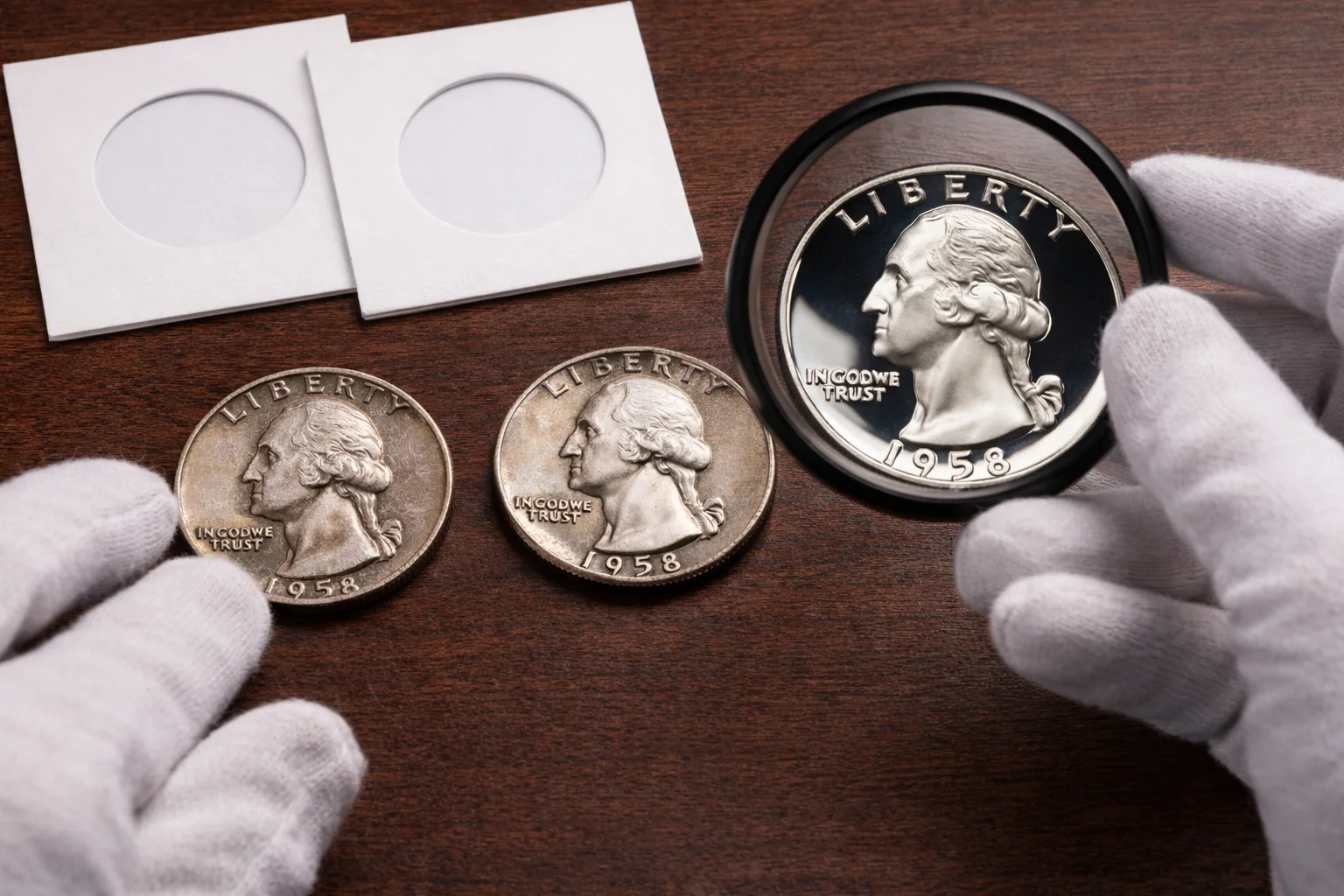
Grade still decides a lot, even after the versions are split. In circulated grades, many 1958 quarters stay near their silver-driven level. In stronger Mint State, the business strikes begin to separate. In proof, finish and contrast push the separation even further.
| Business strikes by grade | General market view |
| Circulated | mostly silver-driven |
| AU / BU | modest premium |
| MS65–MS66 | stronger collector interest |
| MS67+ | scarce, auction-sensitive |
| Proof by grade / contrast | General market view |
| Proof | collectible but often available |
| CAM | stronger premium |
| DCAM | top proof premium tier |
The tables show the main pattern. A date coin becomes a better market coin only when the quality supports it. That is true for 1958-P, 1958-D, the proof, and the Type B Reverse alike.
FAQs
Is a 1958 quarter always silver?
Yes. The 1958 Washington quarter is a 90% silver, 10% copper coin in all the main versions discussed here.
Is a 1958-D quarter worth less than a 1958 quarter?
Not always. In lower grades, the values can be close. In stronger Gem and top-pop grades, the 1958-D can be more difficult and can bring stronger prices.
Are 1958 proof quarters rare?
Ordinary proofs are collectible, but not rare in an absolute sense. NGC says only the Ultra Cameo level is truly rare, and the market premium rises sharply with stronger contrast.
What is the Type B Reverse on a 1958 quarter?
It is a recognized Philadelphia variety with proof-style reverse details. The key markers are the clearly separated ES in STATES and the higher-relief E PLURIBUS UNUM.
Does lower mintage make the 1958 Philadelphia quarter rare?
Not by itself. The mintage is lower than Denver’s, but many rolls were saved. That makes the coin easier in Gem than the raw mintage might suggest.
Which 1958 quarter is the most interesting to specialists?
The answer depends on the collector. Some focus on top-grade 1958-D coins. Some prefer deep cameo proofs. Many specialists look hard at the 1958 Type B Reverse because it adds a true variety angle to the date.
Final Take: Which 1958 Quarter Deserves the Most Attention?
Each version matters for a different reason. The 1958 Philadelphia quarter matters because of its lower mintage and its Type B Reverse potential. The 1958-D matters because better survivors are tougher than many collectors expect. The proof matters because contrast and surfaces can move the coin far beyond the level of a normal silver quarter.
That is the cleanest way to read the 1958 quarter value. Do not treat the date as one market. Treat it as four related lanes. A free coin identifier app such as Coin ID Scanner can help here in a more practical way than many collectors assume: by keeping coin cards with specifications in one place, letting you compare saved examples side by side, and helping organize Philadelphia, Denver, proof, and Type B pieces inside one collection instead of mixing them together.
Coin ID Scanner’s official materials highlight detailed coin information, saved collection features, and a large coin database, which fits this kind of version-by-version work well.